
Avoid Car Trouble with a Belt Check
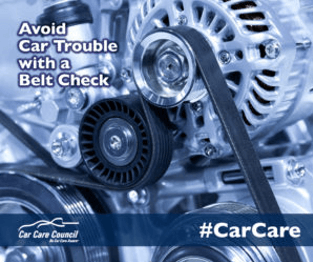
You may not see them, or know much about them, but engine belts are always working to keep your vehicle moving. Losing a belt can mean immediate trouble for the engine and a breakdown for you. To avoid being stranded, the non-profit Car Care Council recommends that motorists review the owner’s manual to ensure that belts are inspected and replaced at the proper intervals.
A vehicle’s belts are essential to the cooling, air conditioning and charging systems of the engine. Serpentine belts are used to turn the water pump, alternator, power steering and air-conditioning compressor. Older cars use V-belts for various accessories.
Always check serpentine and V-belts for looseness and their overall condition. Replace V-belts when cracked, frayed, glazed or showing signs of excessive wear. Noise in the belt system is a sign of wear and the smell of burnt rubber can indicate a slipping belt. When changing a serpentine belt, it is important to check all the components in the serpentine system as tensioners and pulleys wear at the same rate as the belt and should be inspected.
Typical serpentine belt replacement is 60,000 to 90,000 miles. Typical V-belt replacement is 40,000 to 50,000 miles. Replace timing belt per interval specified in the owner’s manual.
“Why risk being stranded when a bad belt can be diagnosed with simple routine maintenance?” said Rich White, executive director, Car Care Council. “Inspecting and replacing belts as specified in your owner’s manual will help you avoid the hassle and expense of a sudden breakdown.”
The Car Care Council’s free 80-page Car Care Guide features several pages of information on the functionality of belts and when to replace them. Available in English and Spanish, the popular guide fits easily in a glove box and can be ordered by visiting www.carcare.org/car-care-guide.
The non-profit Car Care Council is the source of information for the “Be Car Care Aware” consumer education campaign promoting the benefits of regular vehicle care, maintenance and repair to consumers. For the latest car care news, visit the council’s online media room at http://media.carcare.org.
To order a free copy of the popular Car Care Guide, visit the council’s consumer education website at www.carcare.org.
The new Synchrony Car Care credit card is now accepted at more than 25,000 automotive service, tire and repair locations, as well as 185,000 fuel stations nationwide.
You might also like

Your schedule depends on equipment being ready to roll. See how consistent fleet maintenance prevents delays and keeps daily operations on schedule.

Noticing odd tire wear? See what those tread patterns may be telling you, what can cause them, and when a simple fix can save your next set of tires.

Your vehicle may be storing clues you cannot see. See how advanced diagnostics uncover what is really happening before repair costs climb even higher.